
PVC Film: Premium Quality for Industrial & Textile Applications
Introduction: Why PVC Film Is Essential for Modern Industries
Across packaging lines, textile factories, and pharmaceutical plants, one material quietly handles tasks that would defeat most alternatives: PVC film. The global PVC film market was valued at approximately $89.56 billion in 2024 and is projected to reach $143.22 billion by 2032, growing at a CAGR of 6.94%. For procurement managers, manufacturers, and product developers, the question is no longer whether to use PVC film — but how to specify it correctly for maximum performance and value.
This guide covers everything you need to know: what PVC film is, the main types available, key benefits, industry applications, how it is manufactured, and how to choose the right grade for your specific requirements.
What Is PVC Film?
Definition & Composition
PVC (Polyvinyl Chloride) film is a thin, flexible plastic material produced from polyvinyl chloride resin combined with plasticizers, stabilisers, and additives. These additives are what give PVC film its wide range of mechanical and visual properties — from rigid and transparent to soft and embossed. The composition is adjusted during manufacturing to achieve the specific hardness, clarity, chemical resistance, and surface finish required for each application.
Key Characteristics
- High flexibility and adaptability — adjustable via plasticiser content to suit rigid or flexible applications
- Excellent transparency and gloss — optical clarity up to 92% light transmittance in high-grade transparent variants
- Strong resistance to moisture and chemicals — suitable for food-contact and industrial environments
- Smooth, printable surface — compatible with gravure, flexographic, and digital printing processes
- Wide processing temperature range — performs reliably from -30°C to 80°C depending on formulation
Types of PVC Film You Should Know
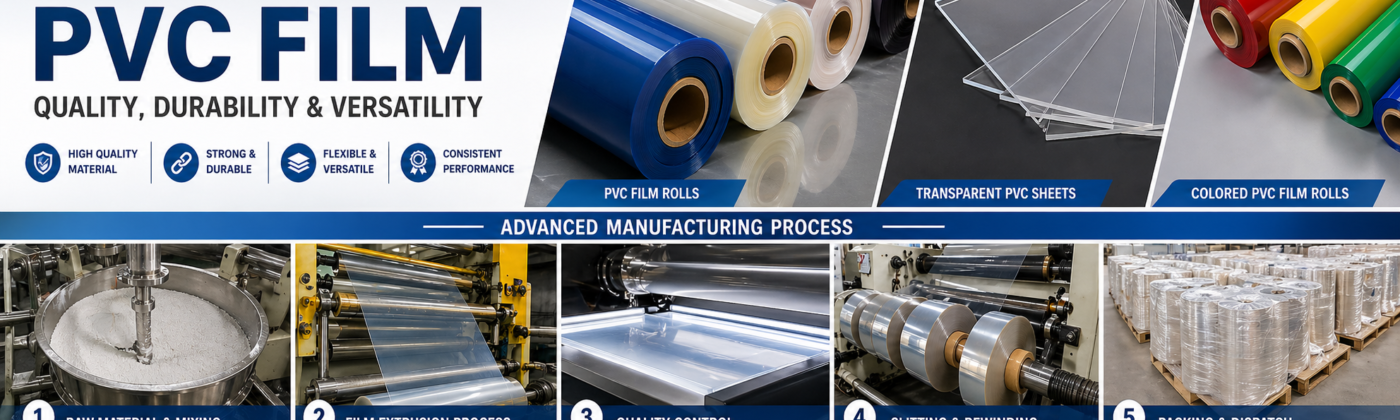
Transparent PVC Film
Transparent PVC film offers high optical clarity and is the most widely used variant across industries. It is ideal for blister packaging in pharmaceuticals, food wrapping, and display applications where product visibility is essential. Medical-grade transparent PVC films undergo stringent quality validation for properties such as ethylene oxide compatibility and puncture resistance — critical for applications like IV fluid bags and sterile packaging.
Coloured PVC Film
Coloured PVC film is produced by incorporating pigments during the extrusion or calendaring process. It is widely used in branding, retail packaging, decorative materials, stationery, and consumer goods where visual differentiation and brand identity are priorities. Colourfastness and pigment stability under UV exposure are important specification parameters for outdoor or long-shelf-life applications.
Matte & Glossy PVC Film
The choice between matte and glossy finishes affects more than aesthetics — it impacts printability, surface friction, light reflectivity, and downstream processing performance. Matte PVC film reduces glare, improves ink adhesion, and provides a premium tactile feel suited to high-end packaging and luxury goods. Glossy PVC film delivers a high-shine finish that enhances visual impact on retail shelves and is commonly used in cosmetics, food packaging, and promotional materials.
Embossed PVC Film
Embossed PVC film features a textured surface pattern applied during the calendaring process using engraved rollers. This adds tactile depth and visual complexity, making it suitable for decorative applications, imitation leather products, furniture lamination, and fashion accessories. The texture also improves grip and masks surface imperfections in end products.
Printed PVC Film
Printed PVC film is customised with brand graphics, patterns, or information using high-volume gravure or flexographic printing. It is used across food packaging, retail displays, and industrial labelling. Metallised and holographic printed variants have demonstrated strong performance in brand differentiation — in cosmetics packaging, for example, holographic PVC films have been shown to significantly increase shelf engagement.
Coated & Laminated PVC Film
Coated PVC film applies a functional layer — such as moisture barrier, antimicrobial, or UV-stable coating — onto the base film. Laminated variants bond two or more layers together to achieve combined properties of strength, barrier performance, and visual finish. These are used in automotive interiors, outdoor signage, and medical device packaging where single-layer films cannot meet the performance requirements.
Key Benefits of High-Quality PVC Film
- Durability and long service life — UV-stabilised formulations can withstand 15+ years of outdoor exposure
- Superior optical clarity and surface finish — critical for packaging applications where product presentation matters
- Moisture and chemical resistance — protects product integrity in humid, industrial, and food-contact environments
- Cost-effectiveness at scale — competitive material cost combined with high-speed processability in extrusion and calendaring lines
- Versatility across processes — compatible with thermoforming, heat sealing, lamination, printing, and die-cutting
- Customisable formulation — thickness, hardness, transparency, colour, and surface finish can all be specified to order
Applications of PVC Film Across Industries
Textile & Fashion Industry
PVC film is used extensively in the textile sector for sequin production, decorative trims, fabric laminates, and accessories. Its ability to be produced in a wide range of colours, finishes, and textures makes it well-suited for fashion applications where aesthetic performance is as important as durability. Embossed and metallic PVC films are particularly valued for high-volume apparel and accessories manufacturing.
Packaging Industry
Packaging is the largest end-use segment for PVC film globally. Applications span food and beverage wrapping, pharmaceutical blister packs, shrink wraps, pouches, and clamshell packaging. PVC film’s combination of transparency, barrier properties, and heat-seal strength makes it a strong performer on high-speed packaging lines. The pharmaceutical segment is among the fastest-growing, driven by increasing use of PVC in blister pack manufacturing for tablets and capsules.
Automotive Industry
Flexible PVC film is applied in automotive interiors for seat covers, door panel laminates, dashboards, and surface protection films. Its ability to replicate leather textures at lower cost, combined with good abrasion resistance and temperature performance, has made it a standard material in vehicle interior manufacturing. Bio-based PVC films with plant-derived plasticisers are increasingly being adopted by automotive suppliers seeking to reduce lifecycle emissions.
Healthcare & Medical Applications
Medical-grade PVC film is used in IV bags, tubing, blister packaging for pharmaceuticals, and sterile device packaging. Films for these applications are manufactured under ISO 13485-certified conditions and undergo multi-point validation for biocompatibility, ethylene oxide compatibility, and moisture barrier performance. The pharmaceutical packaging segment is projected to register one of the strongest growth rates through 2034.
Construction Industry
In construction, flexible PVC film is used for waterproof membranes, temporary site protection, roofing underlays, and decorative surface laminates. UV-stabilised grades are particularly important in this sector, where materials must maintain performance over extended outdoor exposure periods.
Stationery & Consumer Goods
PVC film is a standard material for folders, book covers, document wallets, protective sheets, and promotional items. Its clarity, printability, and low cost make it the default choice for high-volume stationery manufacturing. Consumer goods applications also include toys, stationery accessories, and retail display materials.
How PVC Film Is Manufactured
Understanding the manufacturing process helps buyers specify the right product and evaluate supplier capability.
- Raw material selection — PVC resin is blended with plasticisers, heat stabilisers, lubricants, UV absorbers, and colourants according to the target specification. The plasticiser content determines flexibility; stabilisers prevent thermal degradation during processing.
- Extrusion or calendaring — Extrusion forces the molten compound through a die to produce film in a continuous roll. Calendaring passes the compound through a series of heated rollers to achieve precise thickness and surface texture. Calendaring is typically used for thicker films and embossed surfaces; extrusion is preferred for thin, optically clear films.
- Coloring and surface finishing — Pigments are incorporated during compounding for solid colours. Surface treatments — including embossing, coating, metallising, and printing — are applied after the base film is formed.
- Precision slitting and cutting — The master roll is slit to customer-specified widths using precision slitting equipment. Dimensional accuracy at this stage is critical for downstream processing on packaging and printing lines.
- Quality control and certification — Reputable manufacturers conduct multi-point inspection covering thickness uniformity, tensile strength, elongation at break, optical clarity, and surface defect detection. For food-contact and medical applications, additional compliance testing against relevant standards (FDA, RoHS, REACH) is required.
How to Choose the Right PVC Film for Your Business
Thickness Requirements
Film thickness directly affects mechanical performance, cost, and processing behaviour. As a general guide: films in the 20–50 micron range are used for flexible food wrapping and light packaging; 80–150 micron for standard blister and clamshell packaging; 200–500 micron for thermoforming, stationery, and construction applications; and above 500 micron (0.5mm) for semi-rigid and rigid sheet applications. Always confirm the thickness tolerance range with your supplier, as variation beyond ±5–10% can cause problems on high-speed processing lines.
Transparency vs. Opacity
For applications requiring product visibility — retail packaging, display, medical blisters — specify transparent or translucent grades with defined haze and light transmittance values. For decorative, branding, or light-blocking applications, opaque coloured or metallised films are more appropriate. Ensure the film’s optical properties are defined in the product specification, not just described qualitatively.
Regulatory Compliance
For food-contact, pharmaceutical, and export applications, compliance with applicable regulations is non-negotiable. Key standards include FDA 21 CFR (US food contact), EU 10/2011 (European food contact plastics), RoHS (restriction of hazardous substances), and REACH (restriction of certain chemicals including phthalates). In Europe, phthalate restrictions are particularly relevant — around 43% of new PVC film products launched in 2025 featured phthalate-free formulations to meet evolving compliance requirements. Always request relevant test reports and certifications from your supplier.
Application-Specific Performance Requirements
Different end-uses demand different mechanical and chemical properties. Pharmaceutical blister packaging requires specific heat-seal strength and moisture vapour transmission rates. Automotive interior films need defined abrasion resistance and temperature performance. Food wrapping films must meet food-contact approval requirements. Define your performance requirements quantitatively — tensile strength (MPa), elongation at break (%), heat-seal strength (N/15mm), moisture vapour transmission rate (g/m²/day) — before approaching suppliers.
Customisation Options
Leading PVC film manufacturers can supply custom thickness, roll width, core size, colour, surface finish, and print design. For branded packaging or decorative applications, gravure-printed custom designs allow high-volume production with consistent colour accuracy. Confirm minimum order quantities and lead times for custom specifications during supplier evaluation.
Sustainability Considerations in PVC Film
Sustainability has become a significant factor in PVC film procurement decisions. Around 41% of industry investment in 2025 was directed toward developing recyclable and sustainable PVC formulations. Key developments include bio-based PVC films incorporating plant-derived plasticisers (which can reduce lifecycle carbon footprint measurably), post-industrial recycled content integration, and phthalate-free formulations that align with tightening European regulations. Buyers sourcing for export markets or sustainability-conscious customers should request information on recycled content, plasticiser type, and end-of-life recyclability as part of supplier qualification.
Why Quality Matters in PVC Film
Low-quality PVC film creates compounding problems across the supply chain. Thickness variation causes processing downtime on packaging and printing lines. Poor plasticiser selection leads to migration issues in food-contact applications and regulatory non-compliance. Inadequate stabilisation results in discolouration and embrittlement during storage. Surface defects compromise print quality and packaging aesthetics. The cost of inferior film is rarely limited to the material price — it extends to line downtime, product rejection, rework, and customer complaints.
For bulk buyers and manufacturers, quality assurance documentation — including test reports, material safety data sheets, and certifications — should be a standard supplier requirement rather than an optional extra.
Why Choosing the Right Manufacturer Matters
Not all PVC film suppliers offer equivalent capability. When evaluating manufacturers, assess the following:
- Consistent quality systems — ISO 9001 certification and documented in-process quality control are baseline requirements
- Customisation capability — can the manufacturer produce to your exact thickness, width, colour, and surface specification?
- Compliance documentation — are test reports for food contact, RoHS, REACH, or other applicable standards readily available?
- Reliable bulk supply — does the manufacturer have sufficient production capacity and inventory management to support your production schedule?
- Technical support — can the supplier provide application engineering support for specification development and troubleshooting?
Conclusion: Invest in Quality for Long-Term Success
PVC film remains one of the most versatile and cost-effective industrial materials available — but its performance is highly dependent on specification accuracy and supplier quality. As the market grows toward $143 billion by 2032, driven by demand across packaging, automotive, healthcare, and construction, buyers who invest in understanding their material requirements and qualifying capable suppliers will hold a consistent competitive advantage.
Choosing a premium PVC film solution from a qualified manufacturer ensures better process reliability, regulatory compliance, product performance, and long-term cost control.
FAQs
What is PVC film used for?
PVC film is used across a wide range of industries including food and pharmaceutical packaging, automotive interiors, textile and fashion manufacturing, construction, medical device packaging, and stationery. Its combination of flexibility, transparency, barrier performance, and processability makes it suitable for both protective and decorative applications.
Is PVC film durable?
Yes — high-quality PVC film is durable and long-lasting. UV-stabilised formulations maintain performance in outdoor applications for 15 years or more. The durability of any given film depends on the formulation, thickness, and environmental conditions of the application. Specifying the correct grade for your end-use is essential to achieving the expected service life.
What thickness of PVC film should I choose?
Thickness selection depends on your application. Light food wrapping typically uses 20–50 micron films; pharmaceutical blister packaging 80–150 micron; thermoforming and stationery applications 200–500 micron. For rigid or semi-rigid sheet applications, thicknesses above 500 micron are standard. If you are unsure, discuss your application requirements with your supplier’s technical team.
Can PVC film be customised?
Yes. Reputable manufacturers offer customisation across thickness, roll width, colour, surface finish (matte, glossy, embossed), print design, and functional coatings. Custom specifications are typically available with minimum order quantity requirements — confirm these with your supplier during the enquiry stage.
Is PVC film food-safe?
Food-contact PVC films are available and widely used in food packaging. Compliance with applicable regulations — FDA 21 CFR (US), EU 10/2011 (Europe), or equivalent local standards — must be confirmed with your supplier and supported by test documentation before use in food-contact applications.
What are phthalate-free PVC films?
Traditional flexible PVC films use phthalate-based plasticisers to achieve flexibility. Phthalate-free formulations use alternative plasticisers (such as DINCH, DOTP, or bio-based variants) to meet increasingly stringent European regulations and customer sustainability requirements. If your application involves food contact, toys, medical devices, or export to EU markets, phthalate-free specification is strongly recommended.
Looking for Premium PVC Film Solutions?
Get high-quality, customisable PVC film designed to meet your exact business requirements. From transparent and coloured films to specialised finishes, we deliver consistent quality for textile, packaging, and industrial applications.
✔ Bulk supply with consistent quality
✔ Custom thickness, colours & finishes
✔ Compliance documentation available on request
✔ Trusted by manufacturers and exporters
Request a Quote Today or speak with our team to find the right PVC film solution for your business.